

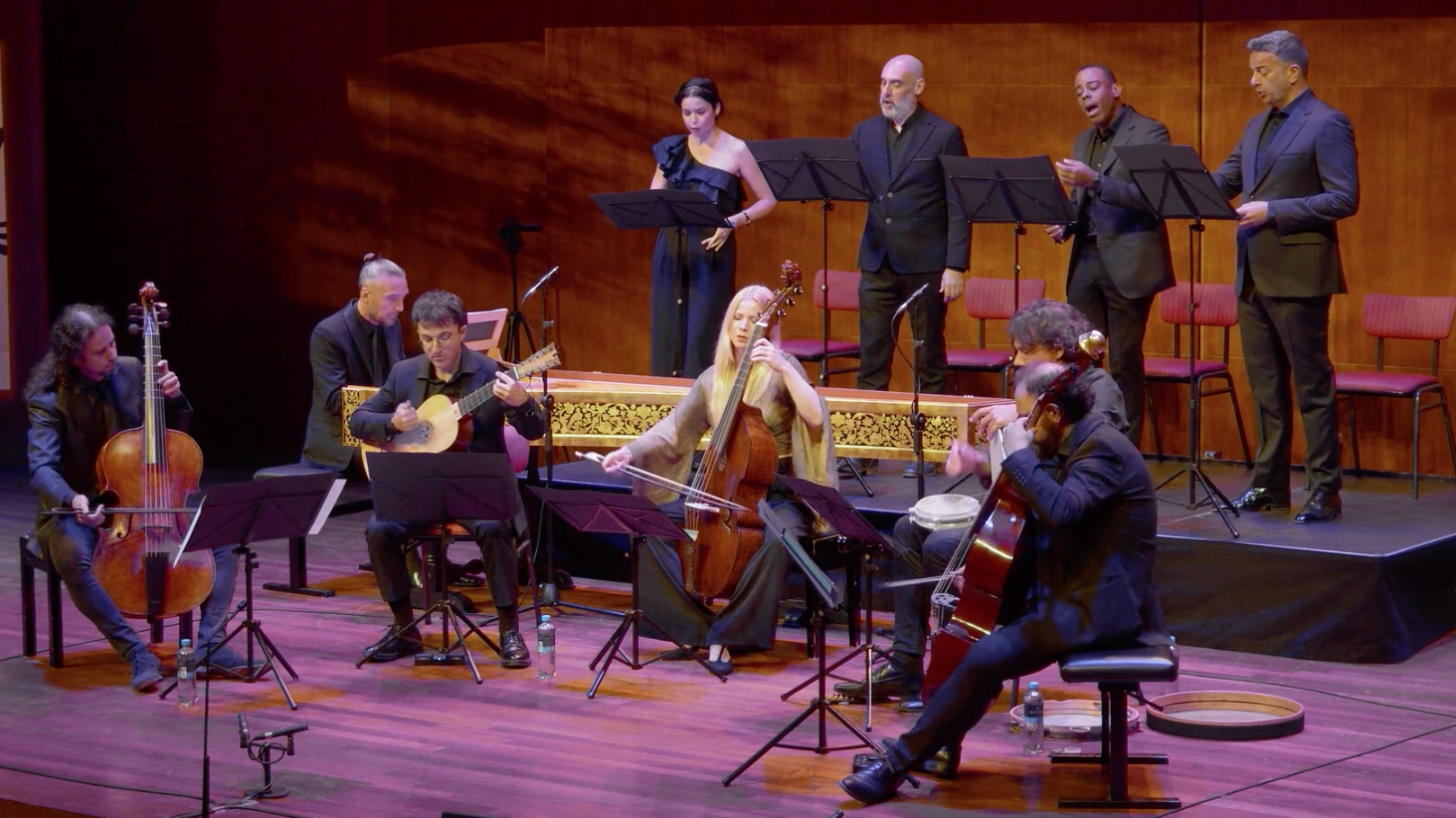
THE CANCIONERO DE LA SABLONARA
ACCADEMIA DEL PIACERE
Fahmi Alqhai, viola da gamba & direction
Rami Alqhai, viola da gamba
Johanna Rose, viola da gamba
Carles Blanch, baroque guitar
Francisco Javier Núñez, harpsichord
Agustín Diassera, percussion
Quiteria Muñoz, soprano
Savid Sagastume, alto
Ariel Hernández, tenor
Javier Jiménez Cuevas, bass
Programme
Gaspar Sanz (1640 – 1710) – Fahmi Alqhai
Pavana
Mateo Romero “Capitán” (1575-1647)
A la dulce risa del alva (folía a 4)
Ay que me muero de zelos (a3)
Aquella hermosa aldeana (romance a4)
Romerico florido (folía a2)
Anonymous & Fahmi Alqhai
Xácaras
Folías de España
Manuel Machado (1590-1646)
Dos estrellas le siguen (a4)
Andrea Falconieri (1585-1656)
La suave melodía y su corrente
Passacalle i Ciaccona, a tre
Anonymous (17th c.) – Fahmi Alqhai
Fandangos
Juan Blas de Castro (c. 1561 – 1631)
Variations on a Joe Satriani Theme
Anonymous
De tu vista celoso (seguidillas a4)
Arrangements: Fahmi Alqhai
Programme notes
The concert took place in the Hertz Hall of the TivoliVredenburg music complex in Utrecht, one of the leading music centres in the Netherlands.
The fire at the Royal Alcázar of Madrid, on Christmas night in 1734, was a terrible tragedy for Spanish music, as it destroyed the court’s music archives, which housed many masterpieces composed in the kingdom’s capital during the 17th century. This sad event makes the Cancionero de La Sablonara, held at the Bavarian State Library in Munich, an essential source for our knowledge of Spanish secular music in the first third of the 17th century. The manuscript was compiled by Claudio de La Sablonara, principal copyist of the Spanish Royal Chapel, for the Count of Neuburg during his stay at the court of Philip IV in Madrid around 1625, and contains the finest court repertoire of the time. Written in a meticulous hand, the songbook contains more than seventy polyphonic tonos, that is, pieces for two, three or four voices. The tonos are set to Spanish poetic forms such as romances, villancicos, endechas and seguidillas, as well as folías, with texts by major authors such as Lope de Vega. They are generally strophic settings in a simple polyphonic style, more homophonic than imitative, continuing the Spanish Renaissance tradition. Yet both their harmony and, above all, their peculiar rhythm introduce innovations that today, with the perspective of centuries, we would call Baroque. Especially characteristic is the constant, unpredictable shift from duple to triple metre and vice versa, a feature that has survived in Spanish music to this day, as in flamenco. To notate these rhythmic shifts, Hispanic composers of the period even devised a distinctive form of chromatic notation, particularly well suited to this repertoire and, in some respects, more effective than modern notation. The works preserved in the manuscript are by some of the most prestigious Iberian composers of the day, such as Juan Blas de Castro, Joan Pau Pujol, Álvaro de los Ríos, Manuel Machado and Juan de Torres, among others. The most notable composer, and the one most widely represented in the songbook, is Mateo Romero, known as “maestro Capitán” (simply “Capitán” in the manuscript). His original name was Mathieu Rosmarin: he was born in Liège, then part of the Spanish Netherlands, and was brought to the Spanish court as a choirboy at barely ten years of age. There, he would succeed his teacher Philippe Rogier as maestro de capilla (chapel master). He is thought to have taught music, particularly the viola da gamba, to King Philip IV. The instrument, known in the chapel as the vihuela de arco, had in fact held a prominent place in the music of the Spanish court for a century already. Today, we will have the chance to recreate its customary role, alternating with the voices and supporting the polyphonic texture.


