A PIACERE
ACCADEMIA DEL PIACERE
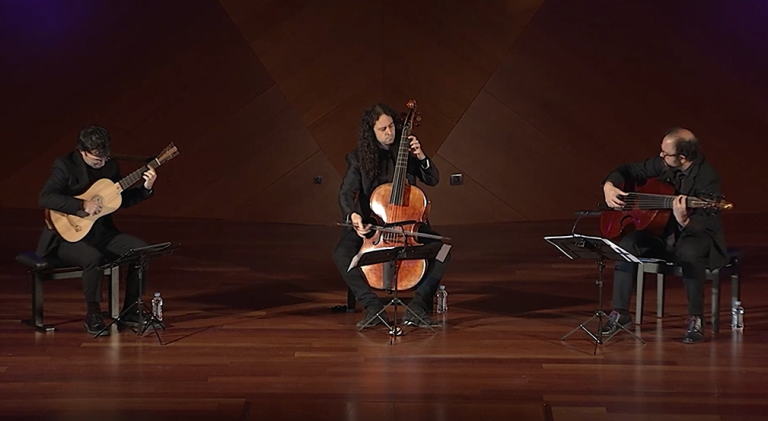
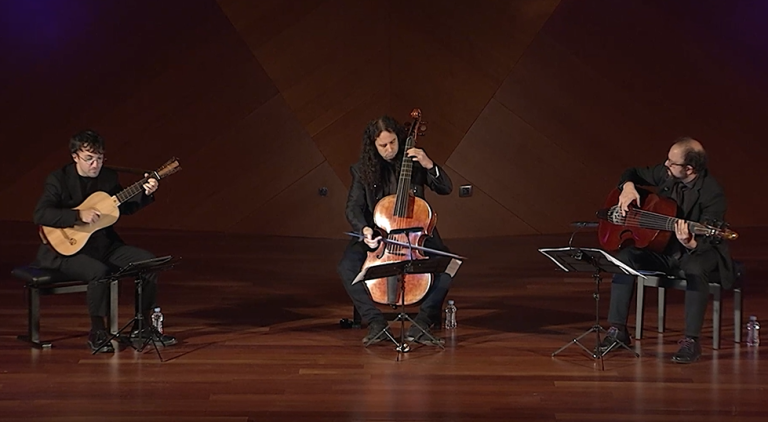
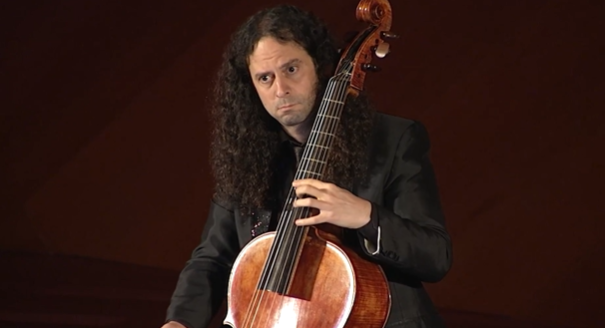
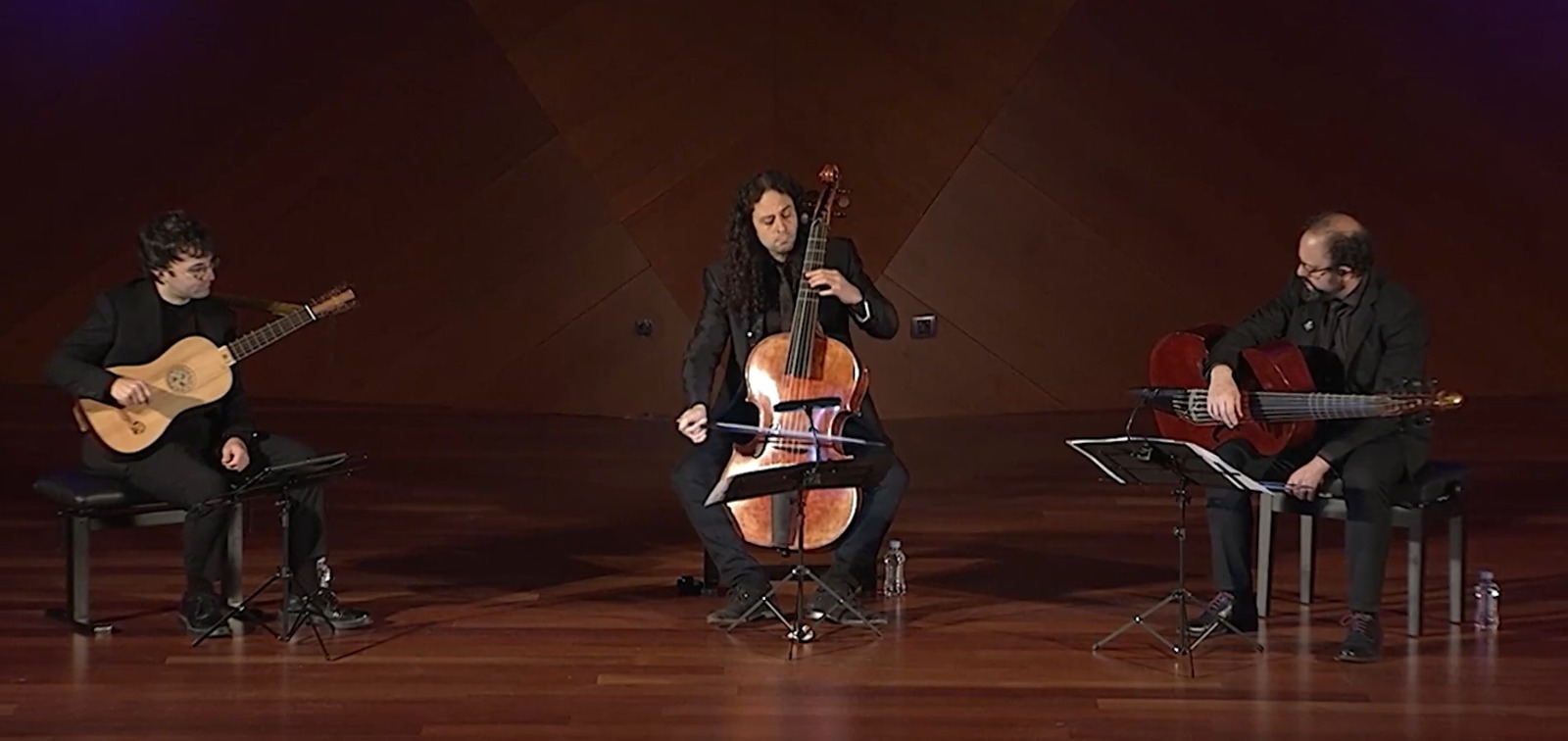
Fahmi Alqhai, viola da gamba & direction
Rami Alqhai, viola da gamba
Carles Blanch, baroque guitar
Programme
Gaspar Sanz (1640 – 1710)
Marizápalos
Marionas
Canarios
Marin Marais (1656-1728)
Folia
L’Arabesque
Les Voix Humaines
Antonio de Cabezón (1510 – 1566)
Tiento I -La Dama le demanda
Jimi Hendrix
Purple Haze
Monsieur de Sainte-Colombe (c. 1640 – c. 1700)
Les Pleurs
Santiago de Murcia (1673 – 1739) & Fahmi Alqhai
Fandangos
Fahmi Alqhai
Variations on a Joe Satriani Theme
Anonymous – Fahmi Alqhai
Variations upon El Cant dels ocells
Arrangements: Fahmi Alqhai
Summary
The concert was held at CentroCentro, a cultural venue in the Palacio de Cibeles, in the centre of Madrid. This municipal centre stands out for its contemporary cultural programming and for hosting concerts and artistic activities within series such as SINETIQ. Música sin etiquetas, devoted to innovative music that knows no stylistic boundaries.
The repertoire of Fahmi Alqhai’s album A piacere explores Spanish and French Baroque music, as well as reinterpretations of popular melodies and modern themes, all adapted to the Baroque viola da gamba. The album brings together works by Gaspar Sanz, Marin Marais and 17th-century anonymous composers, alongside transcriptions of contemporary pieces by Jimi Hendrix and Joe Satriani, showing the instrument’s versatility. Accademia del Piacere delves into the expressive and ornamental world of the viola da gamba, revealing the rhythmic and melodic richness of each work, from popular dances to deeply introspective pieces such as Les Pleurs or Les Voix Humaines.
Programme notes
For centuries, the viola da gamba was the dominant instrument, in its countless variants, on the European musical scene. It declined along with the aristocratic world at the end of the 18th century. That decline not only condemned it to a long period of obscurity but also fixed a particular aesthetic in the collective imagination: that of its last period of splendour in the France of Louis XV, where it came to be seen as an intimate, decadent and melancholy instrument. And that image still holds today as its defining essence.
However – without, of course, overlooking the appeal of that aesthetic, that repertoire and its model of the instrument – the countless types, performing styles and repertoires that the viola da gamba embraced during its almost three centuries of dominance tend to be left in the background. Between its beginnings, associated with Morisco music in Spain, and the virtuoso Berlin repertoire of the 18th century, by way of Italian diminutions and the English popular repertoire of the 17th century, the instrument lent itself to every imaginable shape, size, scoring and tuning: from the small quinton to the great violones; from the singing jeu de mélodie to the rich chords of the jeu d’harmonie; from the lyra viol and its endless settings to the resonant seven-string viol of Sainte-Colombe; from the solo repertoire to the role of continuo player, the English consort, mixed ensembles with German violins, duets for equal voices, concertos with orchestra…
Perhaps this was what most drew me to what would become my instrument: that no two were ever alike, that it was never standardised, that it never let itself be tamed, as happened with the others studied in conservatoires today. There was no sonority, social class or musical style alien to the viola da gamba, and rather than an instrument we should speak of a whole world of instruments. Historical iconography reveals as much: the dozens of paintings and engravings that portray it never repeat a model. We find hardly any invariable features among them beyond being a viola (a bowed instrument) and da gamba (played between the legs); everything else changed from city to city, from palace to street, from musician to musician.
The generations of viola da gamba players of the second half of the 20th century, with the father of the modern viola da gamba, Jordi Savall, as vanguard and beacon, recovered many of those worlds and sonorities and prepared the instrument to realise its capabilities as a fully fledged member of today’s instrumentarium. Sometimes wrongly perceived – sadly, so often by viola da gamba players themselves – as technically limited compared with other instruments, it is on the contrary far more flexible, and potentially as complete and complex as any of them. It need not imitate them, but it can, and must, compete with them.
It falls to our generation of viola da gamba players to break down barriers – probably more mental than real: only persevering work can prove it – and to hand the next generation the technical tools and the artistic courage to eliminate once and for all any trace of an inferiority complex, often disguised as mysticism and esotericism, without renouncing the uniqueness of an instrument full of its own resources. The viola da gamba sings, and accompanies its own song; it weeps, laments and suffers, but it also cries out, tears and hurts; it is sun and moon, day and night… That said, to see, feel and draw from the instrument this whole great palette of colours, we must definitively leave Sainte-Colombe’s cabin – I do not mean forget it – and look to a new horizon where our destination is art tout court, music without labels, and where the musician’s first need emerges from within us: love for that marvellous muse that is the viola da gamba, and fusion with it to convey beauty and emotion.
In short, my wish with this CD is for the viola da gamba to contemplate, from its own particular perspective, repertoires distant in space and time, without artistic or technical self-limitation and exploiting its resources to the full: from 17th-century Spanish music to the most classical repertoire of the French viola da gamba, by way of
Bach and Rameau and reaching out towards popular and present-day music, the model of viola da gamba best suited to each repertoire gives us the key to entering the thousand sonorities hidden in our instrument. A more open attitude may allow us to break down some barrier and take one more step forward with it, in the hope that the viola da gamba continues on its path of growth and never again falls into another long and gloomy oblivion.